


OrloNow began with an uncomfortable realisation: its founders had become part of the problem
They were trying to understand. Living in Greater Noida, they had become regular Quick Commerce users themselves. Like millions of households, they loved the convenience. Ordering groceries through an app had become easier than stepping out to the neighbourhood market.
Then two of the strongest kiranas in their neighbourhood shut down.
These were not obscure or badly run shops. They had customers, local relationships and years of trust. Yet a growing share of consumer spending — including the founders’ own — was moving to apps. That forced the team to look at its own shopping behaviour differently: they were not merely observing the shift in neighbourhood retail; they had become part of it.
But there was another contradiction. Quick Commerce had made grocery shopping faster and more convenient, yet it still did not always complete the family grocery basket. One app might have the preferred bread.
Another had the right milk. A third had a particular sauce or health product. Fresh vegetables, a
A regional brand or a familiar pack size could still mean falling back on the local store.
That led to one simple question: why should one family need three or four apps — and still fall
back on a neighbourhood kirana — just to complete one grocery list?
The answer became the foundation of OrloNow: the neighbourhood often did not lack products. It lacked coordination.
One kirana cannot beat a dark store. Ten can.
OrloNow’s thesis is built around coordination rather than replacing neighbourhood retail. One kirana may not be able to offer every product a family wants. But across 10–12 stores in the same neighbourhood, much of that complete basket already exists.
OrloNow is building an AI-led coordination OS designed to make those independent stores work as one demand-facing network. One store may be strong in everyday essentials, another in fresh produce, another in health or specialty products, and another in the exact brands or pack sizes local households prefer.
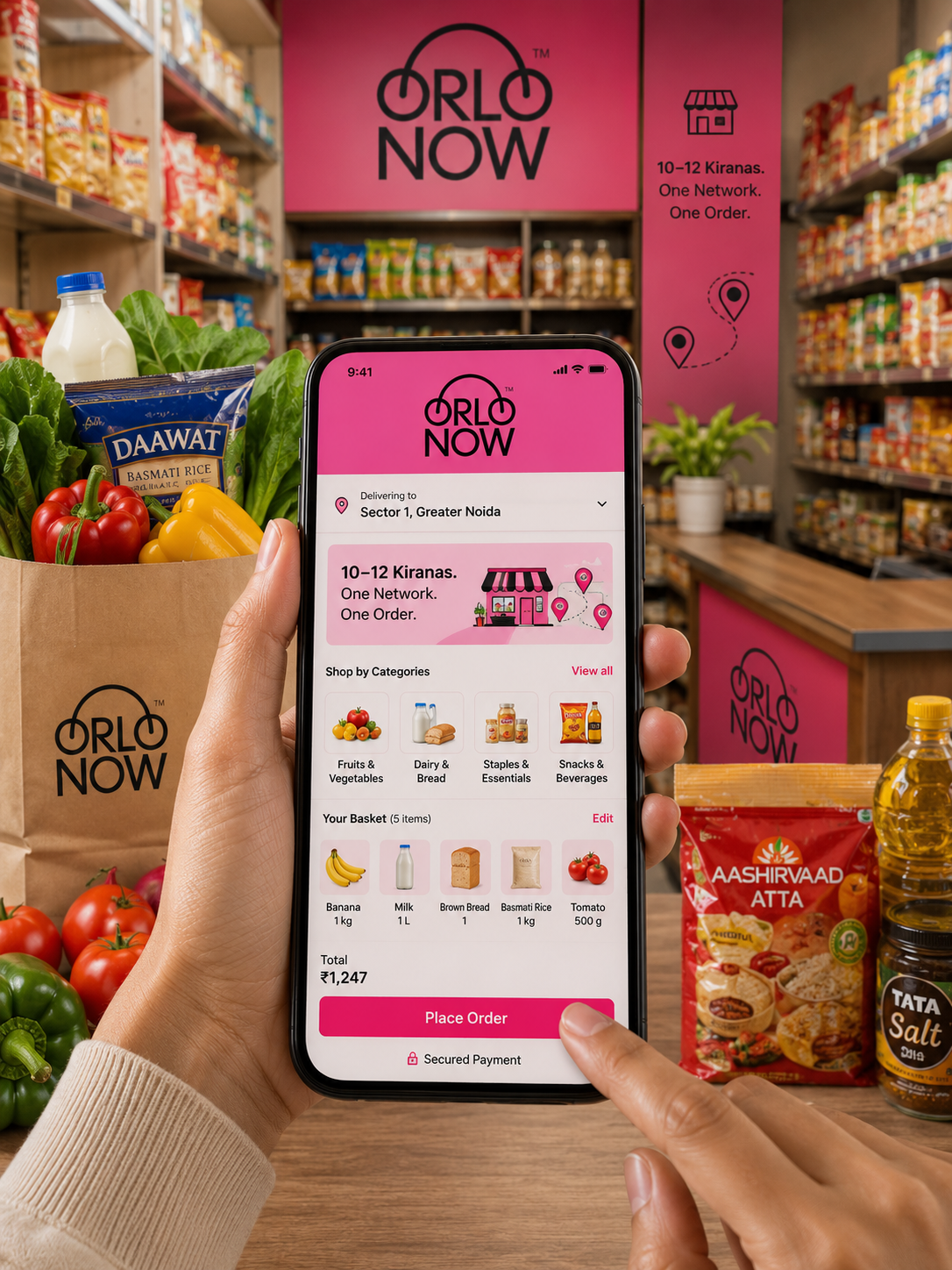
For the household, the proposition is deliberately simple: one complete, preferred grocery basket in one order. OrloNow does not own inventory and does not build dark stores. The idea is to make the retail infrastructure that already exists in the neighbourhood works together far more intelligently.
The missing layer is coordination, not digitisation
OrloNow does not position itself as anti-Quick-Commerce. In fact, its founders describe the company as a consequence of the behavioural shift Quick Commerce created.
Quick Commerce trained households to expect digital convenience and dependable doorstep fulfilment.
OrloNow is asking whether neighbourhood retail can deliver a compelling digital experience through existing local infrastructure, without every solution requiring another warehouse or dark store. The distinction is important. India has already seen POS systems, kirana apps, digital catalogues, marketplaces and B2B procurement platforms. OrloNow is not simply trying to put individual kiranas online. It is trying to coordinate multiple independent stores so that, from the consumer’s point of view, the neighbourhoods can behave like one organised network.
An AI-led OS, built to become increasingly agentic
OrloNow has built four connected applications covering the Consumer, Store, Rider and Cluster Manager /Control Tower.
These applications form the operating surface of the network.
Underneath them, OrloNow is building the AI-led coordination layer. As households repeat, the system is designed to learn what each family buys, which brands it prefers, when those products are likely to be needed again, and which neighbourhood stores fulfil those needs reliably.
Over time, that allows the system to move beyond simply helping a customer search and shop. The ambition is for OrloNow to become increasingly agentic — understanding recurring household intent and coordinating fulfilment on the household’s behalf.
The long-term consumer experience is deliberately simple: “Send me the usual.”
Small proof. Real behaviour.
The first founder-funded proof in Greater Noida is deliberately small, but it has produced real consumer behaviour. OrloNow has completed 45 paid orders worth ₹13,470, with zero refunds or cancellations. One household placed 22 orders in 34 days, while another placed 14 orders in 79 days.
www.orlonow.in
What makes the early signal especially interesting is how it happened: no advertising, no discounts and no incentives. The initial trigger was simply one neighbourhood kirana sharing OrloNow on its WhatsApp status.
These households already had multiple grocery apps on their phones. They still installed another one — and some of them kept coming back.
OrloNow is not presenting 45 orders as scale. The signal is simpler: the problem was real enough for households to try a fifth grocery app, and repeat behaviour appeared without paid acquisition or discounting.
Next stop: Tier 2 India
The company’s immediate focus is to prove the model deeply in a Tier 2 city such as Indore or Bhopal. OrloNow believes these markets are especially relevant because neighbourhood kiranas remain deeply embedded in household grocery buying, understand regional brands and pack sizes, and already possess the local trust and physical reach that digital commerce often has to recreate from scratch. Over the first two years, OrloNow aims to build and replicate its cluster model across Tier 2 cities. By Year 3, it plans to begin entering Tier 3 markets, with the longer-term ambition of becoming part of the backbone of neighbourhood commerce in these cities by Year 5.
The larger opportunity goes beyond grocery delivery. As more households and stores participate, OrloNow aims to connect household demand, neighbourhood supply, fulfilment and eventually brands through one intelligent local network.
For the consumer, however, the proposition should always remain simple:
One complete grocery basket.
One order.
One coordinated neighbourhood. And eventually: “Send me the usual.”