

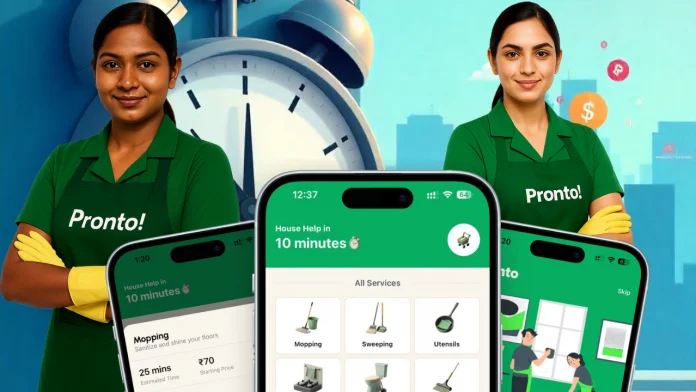

In a shocking move few saw coming, Pronto — a lightning-fast home services startup that raised $2 million from Bain Capital — is preparing to pack up its U.S. legal base and shift back to India.
Why would a hot new startup abandon the world’s biggest startup ecosystem in Delaware… less than a year after launching?
The answer reveals a growing behind-the-scenes trend in Indian tech — and Pronto is playing it smarter (and earlier) than almost anyone else.
Pronto’s Big Flip: The U.S. Exit No One Expected
Most startups wait until they’re gearing up for an IPO before they even think about changing their legal home. Meesho, Groww, Razorpay, and others took years before they finally reversed their U.S. registrations and returned to India.
But Pronto, founded in late 2024 by Anjali Sardana, is making the move in under 12 months.
Why the rush? Because Pronto isn’t trying to impress Silicon Valley — it’s building only for India.
Its platform offers ultra-fast, on-demand domestic help — cleaners, laundry workers, cooks — delivered to your door in just 10 minutes. Think “Swiggy for home services.”
And unlike global tech giants, Pronto has no customers in the U.S., no team in Delaware, and no need to stay attached to American red tape.
From Ivy League Classrooms to Indian Households
Anjali Sardana, Pronto’s founder, was once a U.S.-based investor and student. Like many founders, she incorporated in Delaware because that’s what global VCs prefer. It helped her raise her first $2 million from Bain Capital Ventures quickly.
But once the business took off in India, she realized the mismatch — a U.S. company operating entirely in India wasn’t just unnecessary… it was expensive.
Other startups that delayed flipping paid the price: PhonePe reportedly shelled out ₹8,000+ crore in taxes to redomicile. Groww paid ₹1,340 crore. And Meesho faced massive restructuring right before IPO.
Pronto doesn’t want that future. So it’s flipping back early — while it still can.
The Secret Cost of Staying in Delaware
For most Indian startups, staying incorporated in the U.S. means higher taxes, messy cross-border compliance, complicated ESOPs, and tough IPO paths.
That’s why the reverse flip — shifting legal registration back to India — is becoming a powerful trend. But very few companies are bold (or early) enough to do it before hitting the big leagues.
Pronto’s move now could save it millions later.
It’s also a sign that India’s startup ecosystem has matured. With domestic VC capital growing and Indian exchanges becoming more startup-friendly, founders are no longer forced to build from the U.S. just to access money or markets.
Not Just Fast. Fair.
What makes Pronto different isn’t just its speed — it’s how it treats workers.
Most home services apps in India operate like gig platforms. Workers get paid by the hour or per job, and the income is unstable. Pronto breaks that model.
It hires its service staff — called “Pros” — on fixed shifts with guaranteed pay ranging from ₹22,000 to ₹26,000 per month. That’s more than double what most domestic helpers make in urban India.
Workers are background-verified, police-checked, and trained in-house. Pronto’s team even helps them open bank accounts and plans to offer health insurance and on-demand salary payouts soon.
It’s not just good for the workers. It’s great for business. Customers love the consistency and professionalism. And more than 70% of them rebook within two weeks.
Scaling at Speed
Pronto isn’t slowing down. In just weeks, the company claims to have crossed 1,000 users in Gurugram — its first market. It’s now preparing to launch 10 more hubs in the city, expand to Mumbai and Bengaluru, and hire 700+ new workers.
Behind the scenes, fundraising is heating up. Sources say the startup is in the final stages of closing a $10–12 million round with interest from General Catalyst, Glade Brook, and Untitled VC.
These are some of the most respected names in global venture capital — and they’re betting on a company that’s ditching Delaware before it’s trendy.
Why Investors Are Still Backing a Reverse Flip
Traditionally, global VCs preferred Delaware because of legal protections, tax clarity, and exit pathways. But that’s changing.
More and more investors are getting comfortable with Indian-domiciled startups — especially if the business is focused only on India. Companies like Zepto, Ola Electric, and PhonePe have paved the way. Pronto is now joining them, just much earlier.
Its early flip signals a longer-term vision. It wants to stay in India, scale in India, and maybe even go public here someday.
And investors like Bain and General Catalyst are backing that vision.
A Bigger Shift Is Underway
Pronto’s reverse flip may sound like a niche legal move, but it’s actually part of a larger story playing out in the Indian startup ecosystem.
The “Delaware default” is starting to crack.
As India grows into a self-sustaining tech economy, with its own capital, IPO markets, and consumer base, founders no longer need to mimic Silicon Valley to succeed.
Pronto’s early move could set a new playbook — flip early, stay lean, and build where your business actually lives.
And if this strategy works, Pronto won’t just be known for 10-minute help. It’ll be remembered as the startup that flipped the script on flipping itself.