

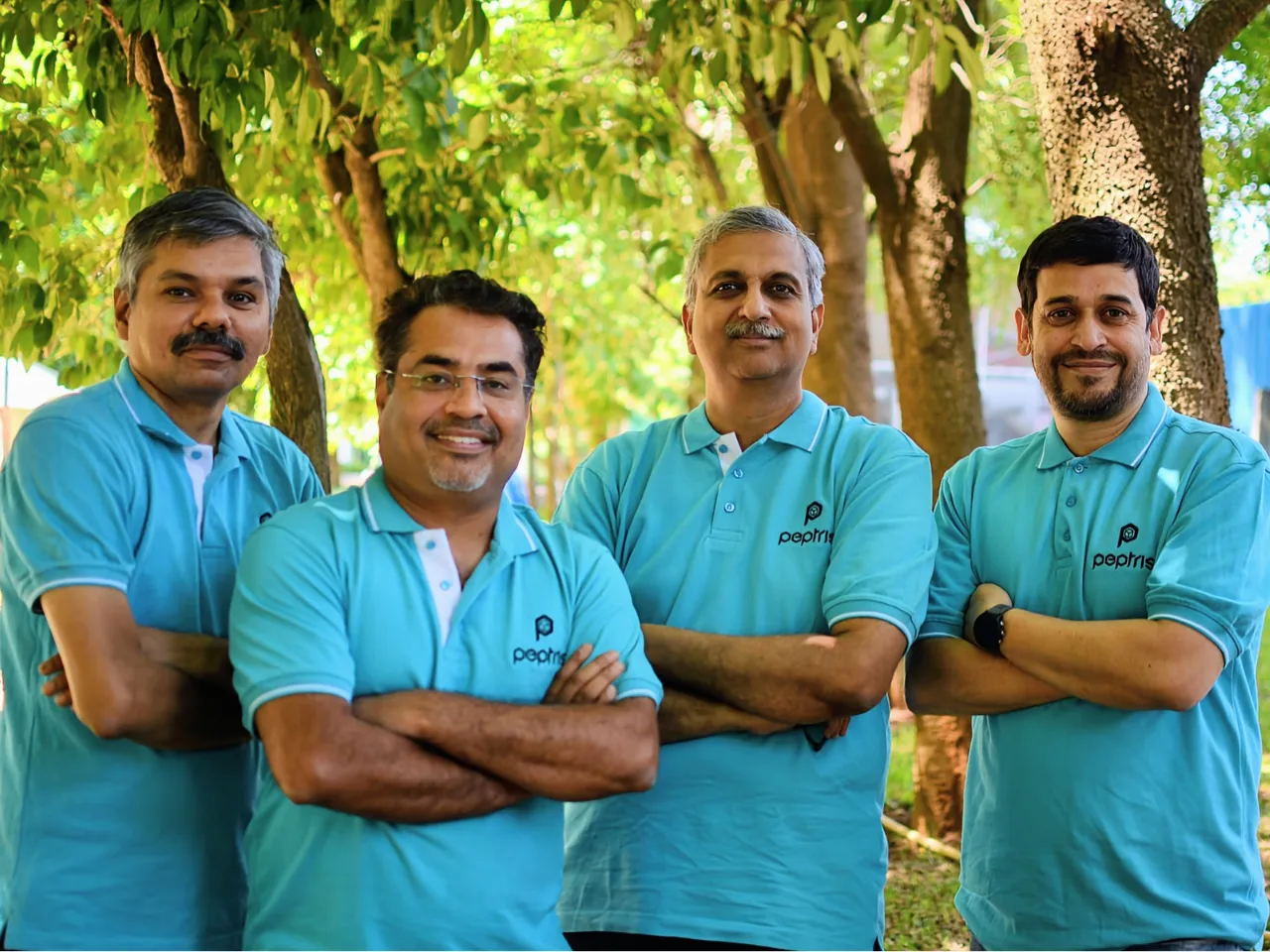

Bengaluru-based drug discovery startup Peptris has raised Rs 70 crore, approximately $7.7 million, in a Series A funding round. The round was co-led by IAN Alpha Fund and Speciale Invest, with participation from Tenacity Ventures, BYT Ventures and other investors.
The fresh capital marks a significant milestone for the young biotech company as it aims to tackle one of the biggest challenges in healthcare: making drug discovery faster, smarter and less risky.
Who Is Behind Peptris?
Founded in 2019 by Narayanan Venkatasubramanian, Shridhar Narayanan, Anand Budni and Amit Mahajan, Peptris was built with a bold vision. The founders saw a critical gap in how new drugs are discovered and developed, particularly in the early stages where most failures occur.
Their solution combines artificial intelligence, data science and deep biological research to reduce uncertainty in early drug development.
Operating from Bengaluru, the startup sits at the heart of India’s growing biotech and deep tech ecosystem.
The Funding Round: Who Invested?
The Series A round was co-led by IAN Alpha Fund and Speciale Invest, two well-known investors in India’s early-stage innovation ecosystem. The round also included Tenacity Ventures, BYT Ventures and other backers.
The Rs 70 crore funding will be used strategically over the next 24 months to strengthen the company’s research pipeline and prepare its lead programmes for clinical readiness.
How Peptris Plans to Use the Rs 70 Crore
The company has outlined clear priorities for deploying the newly raised capital.
Advancing Lead Programmes
Peptris plans to push its most promising drug candidates closer to clinical readiness. Reaching the clinical stage is a major milestone in drug development, as it signals the transition from laboratory research to testing in humans.
Expanding the Discovery Pipeline
Drug discovery is not a one-product game. Companies need a strong pipeline of potential molecules to ensure long-term success. Peptris aims to broaden its discovery portfolio to increase the chances of breakthroughs.
Building Stronger Teams
The startup also plans to strengthen its teams across biology, chemistry, data science and artificial intelligence. Drug discovery is a multidisciplinary effort, and having strong expertise in each area is essential for success.
Why Drug Discovery Is So Difficult
Despite decades of scientific progress, drug discovery remains slow, expensive and risky.
Developing a new drug can take more than a decade and cost billions of dollars globally. A large percentage of drug candidates fail during development, often in the early stages before they even reach human trials.
The pre-clinical phase is particularly challenging. During this stage, researchers test molecules in laboratory settings and animal models to evaluate safety and effectiveness. Many promising candidates are abandoned due to:
-
Unpredictable biological responses
-
Toxicity issues
-
Poor absorption or stability
-
Limited funding and time pressures
These failures not only delay innovation but also significantly increase costs.
Peptris’ AI-Driven Approach
Peptris believes that artificial intelligence can dramatically improve this process.
The company has developed AI models designed to generate novel molecules and predict key parameters that are critical to successful drug development. Instead of relying solely on traditional trial-and-error methods, Peptris uses computational tools to guide decision-making early in the process.
Generating Novel Molecules
One of the platform’s core capabilities is designing entirely new molecules with desired properties. AI models can analyze large datasets and identify patterns that humans might miss, enabling the generation of innovative chemical structures.
Predicting Critical Parameters
Before a molecule becomes a drug candidate, researchers must evaluate several factors, including safety, stability, potency and how the body processes it. Peptris’ platform aims to predict these parameters early, reducing the chances of costly late-stage failures.
Reducing Risk in Early Research
By improving candidate selection and optimization in the pre-clinical stage, the startup hopes to address a structural bottleneck in drug discovery. Smarter early decisions can save years of work and millions in investment.
The Bigger Impact on Healthcare
If successful, AI-driven platforms like Peptris could transform how medicines are discovered.
Faster and more efficient drug development means:
-
Shorter timelines to bring therapies to patients
-
Lower development costs
-
Higher probability of success
-
More innovation in neglected or complex diseases
For patients waiting for new treatments, these improvements could make a meaningful difference.
Bengaluru’s Growing Biotech Ecosystem
Peptris’ growth also reflects the rising strength of Bengaluru as a biotech and deep tech hub. The city has increasingly become home to startups that blend cutting-edge science with advanced computing technologies.
Investors are showing strong confidence in AI-led biotech ventures, especially those that address core inefficiencies in global healthcare systems.
What Lies Ahead for Peptris
The next two years will be crucial for Peptris. Advancing programmes toward clinical readiness requires scientific rigor, regulatory planning and sustained funding.
While AI offers powerful tools, drug development remains complex and unpredictable. The real test will be translating computational predictions into clinically successful therapies.
However, with fresh funding, experienced founders and strong investor backing, Peptris appears well-positioned to push forward.
A Step Toward Smarter Drug Development
Drug discovery has long been described as a high-risk, high-cost endeavor. By integrating artificial intelligence into the earliest stages of research, Peptris aims to rewrite that narrative.
The Rs 70 crore Series A round is not just another funding milestone. It signals growing belief in AI-powered biotech innovation from India. As Peptris works toward clinical readiness and expands its pipeline, it could play a meaningful role in shaping the future of how new medicines are discovered.