


As India aggressively pushes to become a global AI powerhouse, Abhishek Singh, CEO of the IndiaAI Mission, has sent a clear message to the country’s AI founders: Building Indian large language models (LLMs) isn’t enough — it’s time to go global.
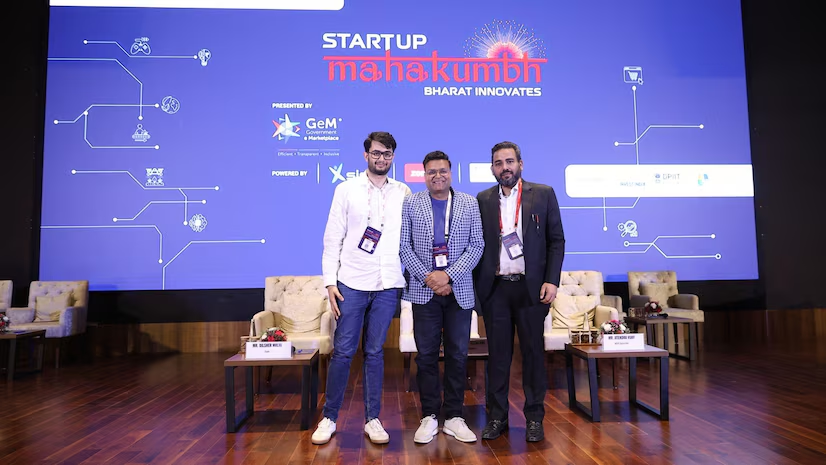
Speaking at a recent panel, Singh emphasized that while India’s strides in developing indigenous AI are commendable, a global outlook is crucial if Indian companies are to compete with the likes of OpenAI, Anthropic, and Google.
The Message: “Global Vision Isn’t Optional. It’s Essential.”
IndiaAI is one of the government’s most ambitious digital initiatives to foster sovereign AI innovation. But Singh made it clear that sovereignty doesn’t mean isolation.
“We’re building for India, but the scale and sophistication required to lead in AI means Indian startups must start building with a global market in mind,” Singh noted.
This is a significant shift in tone. The government wants Indian AI to be made in India, for the world.
Who’s Building India’s LLMs?
India has seen a flurry of AI activity in the last 12 months. Some of the country’s most exciting startups are working on foundational LLMs, including:
- Sarvam AI – Working on a 70-billion parameter multimodal model with capabilities in Indian languages and English
- Soket AI, Gnani.ai, and Gan.ai – Developing speech, video, and multilingual models for enterprise and creator use cases
- Several stealth-mode ventures incubated under IndiaAI’s funding ecosystem
While these startups are solving for local linguistic and cultural challenges, Singh believes their technology and talent can rival the best globally — if they start thinking beyond just India.
Why Now? Timing Is Everything
Global AI funding is shifting, and while the U.S. and China lead in capital and compute infrastructure, India offers unique strengths:
- A diverse, multilingual population ideal for training robust AI
- A rapidly digitizing economy
- Affordable talent and growing R&D support from the government
- A hunger for leapfrog innovation in areas like health, education, and governance
But without a global monetization model, Singh warns, “we risk falling behind despite our innovation.”
The IndiaAI Global Acceleration Programme
To help close that gap, the IndiaAI Mission recently selected 10 homegrown AI startups for its Global Acceleration Programme — a partnership with Station F and HEC Paris.
The program will offer:
- Mentorship from global AI experts
- Access to international VCs and partners
- Help in building cross-border go-to-market strategies
- A platform to position India as an AI-exporting nation
This is IndiaAI’s first major push to put Indian AI startups on the global startup map — and it’s just the beginning.
What’s at Stake: Will India Build the Next OpenAI?
Indian AI talent is world-renowned, but most of it still powers foreign firms. Singh and his team want that to change.
“Why shouldn’t the next GPT come from India? We have the data, the people, the ambition — now we need the global mindset,” he said.
That means founders need to:
- Build models that work beyond Indic languages
- Package solutions for enterprise-grade global use cases
- Collaborate with global research and commercial partners
- Set international benchmarks for safety, ethics, and performance
Final Word: Made in India, Built for the World
The call to action from the IndiaAI Mission CEO is loud and clear — don’t just build for Bharat, build for the world.
For AI startups in India, this is the moment to think bigger, scale faster, and compete globally. The next frontier of tech leadership is being drawn, and India has a real chance to shape it — if its AI innovators are bold enough to aim beyond borders.