

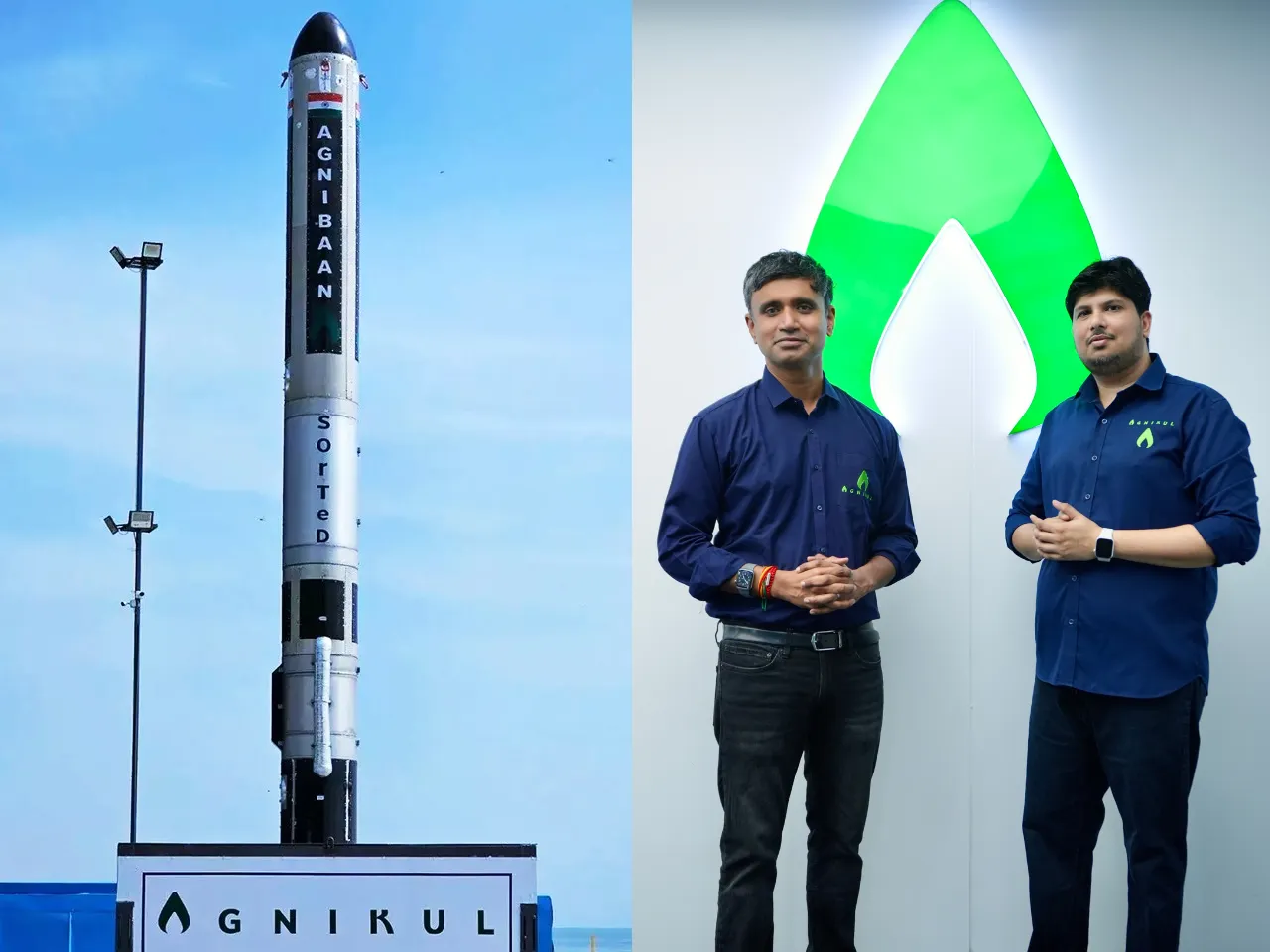

Agnikul Cosmos Raises Big Funding to Revolutionize Space
Chennai-based spacetech startup Agnikul Cosmos, known for building the world’s first single-piece 3D-printed rocket engines, has raised Rs 150 crore ($17 million) in a fresh funding round at a valuation of nearly Rs 4,500 crore ($500 million).
The round saw participation from family offices and marquee investors such as Advenza Global Limited, Atharva Green Ecotech LLP, HDFC Bank, Artha Select Fund, Prathithi Ventures, and 100X.VC, highlighting growing investor confidence in India’s private space sector.
Scaling Production and Building a Space Campus
Agnikul plans to deploy the funds in scaling production units for aerospace and rocket components while advancing its stage-recovery program. The startup is also focusing on developing an integrated space campus on the 350 acres allocated by the Tamil Nadu Government, which will house end-to-end facilities for manufacturing and testing launch vehicle systems.
CEO and Co-founder Srinath Ravichandran emphasized that previous successful controlled ascent launches have validated Agnikul’s patented technologies with the support of ISRO and IN-SPACe, allowing the startup to scale operations.
Ravichandran said the new funding will help the company work on lower stage recovery and upper stage extension, innovations aimed at improving the unit economics of launch services. He added that the goal is to increase launch frequency and build for the world, from India.
Pioneering Reusable Rocket Technology
Agnikul is also focused on strengthening its reusable launch architecture. The startup recently secured a patent extending the operational life of upper stages, marking a significant step toward developing the world’s first recoverable small-satellite launch vehicle.
By enabling reusability, the company aims to reduce launch costs, making orbital access more affordable for commercial and scientific missions. This innovation is expected to position Agnikul as a global leader in small-satellite launch services.
Co-founder and COO Moin SPM highlighted that the combination of 3D-printed engines, patented reusable technologies, and a fully integrated production campus sets Agnikul apart from other private spacetech companies.
Why Investors Are Excited
The private space sector in India has been gaining momentum, with companies like Skyroot, Bellatrix Aerospace, and Agnikul Cosmos pushing the boundaries of innovation. Investors see Agnikul as a pioneering startup capable of making India a key player in global small-satellite launches.
The Rs 150 crore funding will enable the startup to:
-
Scale production of rocket components.
-
Advance stage recovery programs for reusable rockets.
-
Build an integrated campus for manufacturing and testing launch vehicles.
-
Strengthen unit economics and operational efficiency of launch services.
Experts believe that Agnikul’s technology could redefine cost structures for small-satellite launches, opening the door for faster, cheaper, and more frequent access to space.
India’s Private Space Revolution
Agnikul’s rise signals the growing potential of India’s private space industry, which is benefiting from supportive policies by IN-SPACe and the Indian government. By combining cutting-edge 3D printing technology with reusable launch systems, Agnikul is aiming to position India as a global hub for cost-efficient orbital launches.
The startup’s strategy to focus on scalable launch systems and reusability aligns with global trends, as space companies worldwide race to make launches cheaper and more sustainable.
The Road Ahead
With this new round of funding, Agnikul Cosmos is poised to accelerate the development of its reusable rockets, increase launch frequency, and expand its technology footprint. The integrated space campus in Tamil Nadu will allow the startup to consolidate all aspects of rocket design, production, and testing, making India a key player in the emerging commercial space market.
CEO Srinath Ravichandran summed it up, saying that the company’s vision is to build for the world, from India, turning patented innovations into a global space launch service.
The startup’s journey represents a major step toward commercial space independence in India and could pave the way for future collaborations, satellite launches, and potentially even international missions.
Agnikul Cosmos is at the forefront of India’s spacetech revolution, combining 3D-printed engines, reusable rocket technology, and a world-class production campus. With Rs 150 crore in fresh funding, the startup is ready to reshape India’s small-satellite launch industry and potentially become the first Indian company to offer recoverable orbital launches.
For investors, space enthusiasts, and the tech world, Agnikul’s story is proof that India is ready to compete with the world in cutting-edge space innovation. The next few years could see the startup achieving milestones that redefine orbital access and cost efficiency, making it one of the most exciting ventures in global spacetech.