

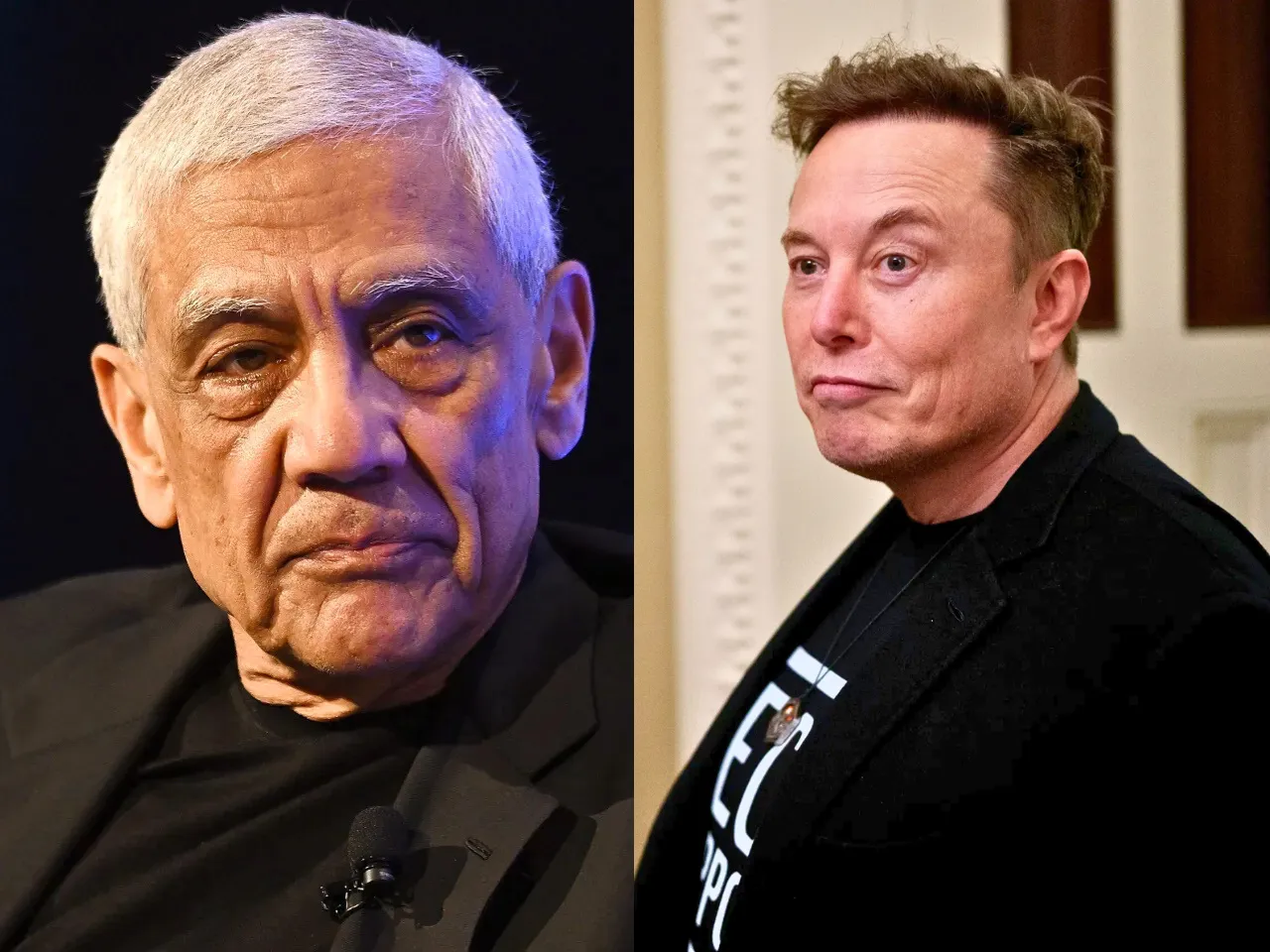

A rare and sharp public clash between two of Silicon Valley’s most influential figures has reignited debates around race, politics, and responsibility in the tech industry. Indian-American billionaire investor Vinod Khosla has urged employees of Elon Musk-led companies to resign, escalating tensions following controversial remarks made by Musk on social media.
The dispute has drawn widespread attention, not just because of the personalities involved, but because it highlights deeper cultural divides within the technology world—divides that increasingly play out in public view.
The Comment That Sparked the Controversy
The latest flashpoint came after Elon Musk posted a message on X stating that white people are becoming a “rapidly diminishing minority” globally.
A Post That Triggered Intense Debate
Musk’s remark quickly went viral, drawing both support and criticism. While some framed the statement as a demographic observation, others saw it as racially charged and potentially inflammatory.
The post fueled an intense online debate about race, identity, and the role influential leaders play in shaping public discourse. For critics, the issue was not just what was said, but who said it—and the platform from which it was delivered.
Vinod Khosla’s Strong Response
Vinod Khosla, co-founder of Sun Microsystems and a prominent venture capitalist, responded forcefully to Musk’s comments.
Calling for Employees to Walk Away
Khosla urged employees of Tesla, SpaceX, and other Musk-led companies to resign if they disagreed with Musk’s views. In his remarks, he suggested that staying silent or continuing to work under such leadership amounted to tacit approval.
Khosla framed the issue as a moral choice rather than a professional one, arguing that employees should consider whether they want to be associated with leadership that promotes divisive narratives.
‘WAGA, Not MAGA’: A Loaded Comparison
One of Khosla’s most pointed remarks was his suggestion that Musk’s worldview aligns more with “WAGA” than “MAGA.”
What the Phrase Implies
The phrase “WAGA” is widely interpreted as a reference to white identity politics, contrasting with the more familiar “Make America Great Again” slogan associated with conservative politics in the United States.
By using this framing, Khosla implied that Musk’s rhetoric goes beyond political positioning and ventures into racial ideology—an accusation that significantly raised the stakes of the dispute.
A Clash of Values in Silicon Valley
The exchange between Khosla and Musk reflects a broader shift in Silicon Valley culture.
From Innovation to Ideology
For decades, tech leaders largely avoided overt political and cultural commentary. In recent years, however, prominent executives have become increasingly vocal on social issues, often blurring the line between personal opinion and corporate influence.
As leaders of companies employing tens of thousands of people, their statements can shape workplace culture, public perception, and even policy discussions.
Employees Caught in the Middle
Khosla’s call places employees of Musk-led companies in a difficult position.
Loyalty vs Personal Values
Many workers join companies like Tesla and SpaceX because of their missions—clean energy, space exploration, and technological progress. Khosla’s comments challenge employees to weigh those missions against the public behavior of leadership.
For some, separating a company’s goals from its CEO’s personal views is possible. For others, leadership values are inseparable from corporate identity.
Musk’s Polarizing Leadership Style
Elon Musk has long been known for his unfiltered communication style.
A Pattern of Controversy
Since acquiring X, Musk has frequently weighed in on topics ranging from free speech to geopolitics and demographics. Supporters argue that he champions open dialogue and resists political correctness. Critics counter that his comments often amplify division and legitimize extreme viewpoints.
This latest controversy fits into a broader pattern that has made Musk one of the most polarizing figures in global business.
Why This Feud Matters Beyond Social Media
While the exchange played out online, its implications extend far beyond a single post.
Impact on Corporate Culture
Public disputes like this can influence hiring, retention, and investor sentiment. In an industry where talent is highly mobile, leadership reputation matters deeply.
Khosla’s remarks suggest that ethical alignment may become an increasingly important factor for employees choosing where to work.
Silicon Valley’s Changing Power Dynamics
The fact that Khosla, a veteran of Silicon Valley’s early days, publicly challenged Musk is notable.
Old Guard vs New Guard
Khosla represents an earlier generation of tech leaders who built companies during a period when Silicon Valley promoted itself as global, inclusive, and largely apolitical.
Musk represents a newer era, where tech leaders openly engage in cultural and political battles. The clash highlights a growing divide over what responsibility, if any, tech CEOs have to moderate their public influence.
Public Reaction Remains Divided
As expected, reactions to the dispute have been sharply polarized.
Supporters on Both Sides
Some praised Khosla for speaking out and holding powerful figures accountable. Others accused him of grandstanding and attempting to pressure employees into political conformity.
Meanwhile, Musk’s supporters defended his right to express opinions freely, arguing that demographic discussions should not be automatically labeled as racist.
What Comes Next
It remains unclear whether Khosla’s call will lead to any meaningful employee departures. Large organizations like Tesla and SpaceX employ diverse workforces with varying views, and public calls for resignation rarely result in mass exits.
However, the episode adds to the growing scrutiny around Musk’s leadership and the cultural direction of his companies.
A Sign of Deeper Tensions in Tech
More than a personal feud, this controversy reflects deeper questions facing the technology industry.
Should tech leaders be held to higher standards of public discourse? Do employees share responsibility for their company’s leadership views? And can innovation-driven companies remain neutral in an increasingly polarized world?
The Bigger Picture
The Khosla–Musk clash underscores how Silicon Valley is no longer just about building products—it is also a battleground for ideas, values, and identity.
As tech leaders wield unprecedented influence, their words carry consequences far beyond social media timelines. Whether this moment fades or becomes a turning point, it highlights a reality the industry can no longer ignore: culture, politics, and technology are now deeply intertwined.